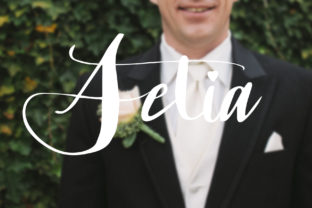
Setia Script Font for Handmade Labels & Wedding Invitations
As someone who designs printable wedding suites, hand-pours soy candles, and cuts vinyl decals for small-batch makers, I’ve learned that the right script font isn’t just about prettiness—it’s about clarity, consistency, and quiet confidence in your brand. That’s why Setia has become my go-to romantic script font for projects where warmth and professionalism need to coexist.
Setia is a lovely script font—fluid but grounded, elegant but never fussy. Its letterforms carry gentle contrast and soft entry/exit strokes, giving it that handwritten charm without sacrificing legibility. Unlike overly ornate scripts that blur at small sizes or choke on cutting mats, Setia balances decorative appeal with real-world function. It feels like ink drawn with care—not rushed, not stiff, not overworked.
I use Setia most often for physical product labels: candle jars, soap wraps, bath salt bags, and boutique tea tins. Its rounded terminals and open counters hold up beautifully when printed at 8–10 pt on matte kraft tags or die-cut sticker sheets. On Cricut Explore and Silhouette Cameo machines, Setia cuts cleanly—even at 0.25" height—because its curves are smooth and its spacing generous. No jagged joins, no collapsed loops. Just clean, confident lettering that customers actually read.
For invitations and wedding stationery, Setia shines as a display font for names, dates, and “Mr. & Mrs.” lines. It pairs naturally with a crisp sans serif (like Montserrat or Poppins) for body text—creating hierarchy without visual noise. I’ve used it for welcome signs painted on reclaimed wood, foil-stamped escort cards, and digital RSVP cards sold as Etsy printables. Because Setia feels personal but polished, couples tell me it makes their stationery feel “thoughtful, not trendy.”
It works equally well for seasonal craft designs. Think: holiday mugs with “Cozy Season” in Setia across the front, farmhouse-style wall art reading “Gather Here,” or printable planner stickers labeled “Self-Care Sunday.” The font’s rhythm invites pause—it slows the eye down just enough to land emotionally, which matters whether you’re selling a $3 sticker pack or a $120 invitation suite.
Readability is where many script fonts falter—but Setia stays clear even in tight spaces. I’ve tested it on 1" round stickers (perfect for jar labels), 1.5" fabric patches for tote bags, and heat-transfer vinyl for cotton tees. As long as you avoid ultra-thin weights or excessive swash characters in those contexts, Setia delivers consistent results. For tiny applications, I stick to the standard lowercase set—no flourishes on the “f” or “y”—and reserve ligatures and alternate glyphs for larger-format pieces like posters or social media banners.
Setia is part of the Script Amp collection, which means it’s designed with crafters and commercial creators in mind—not just graphic designers. You’ll find it delivered in OTF and TTF formats, compatible with Canva, Adobe Creative Cloud, Cricut Design Space, and Silhouette Studio. While it doesn’t include extended multilingual support (no Cyrillic or Vietnamese glyphs), it covers full Latin A–Z, numerals, punctuation, and common accents—enough for English-first shops serving global markets through Etsy or Shopify.
Font pairing is intuitive with Setia. Its soft curves love the structure of a friendly sans serif—think Inter for web templates or Quicksand for playful greeting cards. For packaging with heritage appeal, I pair it with a warm serif like Playfair Display—but only for headings. Never try to set paragraphs in Setia; it’s a display font, not a text face. Use it for names, titles, short phrases, and signature lines—where impact matters more than volume.
One practical note every small shop owner should know: Setia comes with a commercial license included. That means you can use it to design and sell physical products (stickers, mugs, apparel), digital downloads (planner pages, Canva templates, SVG bundles), client work (logo lockups, branded signage), and even sub-license within your own template kits—as long as you’re not reselling the font file itself. No hidden fees, no usage caps. Just straightforward permission to grow your craft business with integrity.
I’ve used Setia on everything from baby shower banners cut from balsa wood to gold-foiled gift tags for luxury skincare brands. It performs reliably across substrates—cardstock, kraft paper, vinyl, ceramic, cotton—and translates well across mockup previews. Customers notice the difference: not because they name the font, but because the typography feels intentional, cohesive, and quietly luxurious.
If you’re building a brand around authenticity—whether you're hand-lettering in Procreate or cutting vinyl at 2 a.m.—Setia supports that mission without demanding perfection from you. It’s forgiving in execution but uncompromising in impression. And in a marketplace crowded with generic scripts, that balance is rare.
So next time you’re choosing a font for your candle label, wedding invite, printable wall quote, or holiday product bundle—ask yourself: does it look handmade *and* hold up under production? Does it say “I made this with care” before the customer even reads the words? With Setia, the answer is yes—every time.